LOGICAL THINKING PROCESS
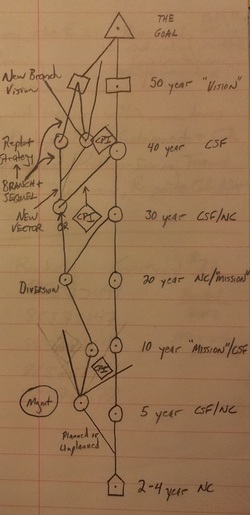
Maybe your business strategy is like the example. You plan for deviation. You plan for uncertainty. You plan to be derailed and hope for clarity to rescue victory from the jaws of defeat!
Wouldn't a method to predict and mitigate risks provide greater stability and achievement of your goal? Whether starting a new business venture, jump-starting stagnant performance, overcoming unpredicted impacts, or solving simple or complex conflicts you need LTP.
The Logical Thinking Process (LTP) brings cause-and-effect order to what seems to be chaos through the Intermediate Objective (IO) Map, Current Reality Tree (CRT), Evaporating Cloud, Future Reality Tree (FRT), Prerequisite Tree (PRT), and Executive Summary Tree. (1)
Each of these products brings deep understanding of your business, competitive and market environments, and analysis of required actions that will shape the future for success. Together, they identify 1) What to Change, 2) What to Change TO, and 3) How to Bring About the Change.
Maybe your business strategy is like the example. You plan for deviation. You plan for uncertainty. You plan to be derailed and hope for clarity to rescue victory from the jaws of defeat!
Wouldn't a method to predict and mitigate risks provide greater stability and achievement of your goal? Whether starting a new business venture, jump-starting stagnant performance, overcoming unpredicted impacts, or solving simple or complex conflicts you need LTP.
The Logical Thinking Process (LTP) brings cause-and-effect order to what seems to be chaos through the Intermediate Objective (IO) Map, Current Reality Tree (CRT), Evaporating Cloud, Future Reality Tree (FRT), Prerequisite Tree (PRT), and Executive Summary Tree. (1)
Each of these products brings deep understanding of your business, competitive and market environments, and analysis of required actions that will shape the future for success. Together, they identify 1) What to Change, 2) What to Change TO, and 3) How to Bring About the Change.
|
|
STRATEGY DEVELOPMENT
Deciding who we are, what we do, and where we are going is essential to business culture development and sustainment. Strategic Alignment and Deployment is the leadership process of identifying what really matters for success. The result is a Strategic Map that provides the company's Vision, Mission, Customers, Products, and Core Processes. |
1) Dettmer, H. W. (2003) Strategic Navigation: A Systems Approach to Business Strategy.